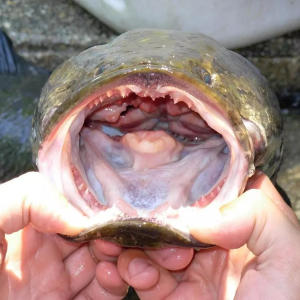
 Peak-a-boo from the latest catch! Is it a snake? A fish? A creepy cross between the two? If the word “frankenfish” fits what’s wriggling round in your net, you may have just met Channa Argus, also known as northern snakehead. This species is very real and raises real concern among conservationists. It’s not your average fish story – this one walks (kind of), hunts (violently), and can outcompete native species. Spotting one isn’t just weird; it’s also a red flag for the health of local waterways. Cast your attention this way! You have an important role to play in cutting the line on the northern snakehead becoming established in the Great Lakes.
So, what’s in the name? A snakehead fish has a long narrow body, with a large mouth containing canine-like teeth. The skin of the fish is very slimy and has patterns reminiscent of a boa or python. They can grow up to four feet in length and weigh over fifteen pounds. It is worth noting this fish can eat other species that are up to thirty percent of its own body size! Native to China, Russia, and Korea, the species was most likely introduced to the United States through unlawful releases from aquariums or fish markets.
That’s right! These lake lurkers are edible. And over the last decade it has gained popularity in restaurant and market trade. It’s hard to say how their fare would hold up against lamprey pie, but the meat of a snakehead is purportedly tender and not gamey. Northern snakehead also gained notoriety as it provides a wild ride for anglers seeking sport fishing. Its hostile tendencies make the reel in quite a tug of war, and the fish will go after a wide array of bait.
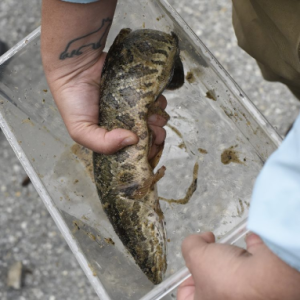 When a fish walks, it is time to pay attention! Their so-called walk is more of a wriggling motion. By ambulating their head and long backfin in different directions, they can thrust forward. Northern snakeheads are obligate breathers, meaning they essentially gulp air to survive. The anatomy of a snakehead includes air chambers next to the gills enabling it to absorb oxygen. The fish can be on land for just shy of a week. In addition to the ability to be on land, this trait allows snakeheads to live in oxygen-deprived waters, and waters with higher temperatures, and shallower depths.
Although not officially holding a spot on the list of invasive species in Ohio, this eerie fish could be a destructive threat. As with most invasive species, it has no natural predators but has traits that allow it to dominate an ecosystem rapidly. Northern snakeheads have a lifespan of roughly 10 years and spawn three to five times in a year. A lone snakehead can produce up to 1,500 eggs with each spawn. The eggs typically hatch within three days, and these fish are known to aggressively safeguard their young.
The status of this fish is listed as: established in the United States but not established in the Great Lakes. The U.S. Fish and Wildlife service are doing everything they can to keep lakes free of this invader and its toothy grin. Chemicals are used in campaigns against the species, in controlled efforts by scientists and researchers. Rotenone is one compound that has been effective in eradication. It works by disrupting cellular respiration in the fish, or in other words it impedes the use of oxygen to produce energy. It is effective in low concentrations, remarkably biodegradable, and does not impact other aquatic friends nearby as it does not tamper with the oxygen in the water.
So, you’ve spotted frankenfish, what’s the move? Report the sighting to the appropriate agencies such as the state’s natural resource department. Don’t release it into the water, no matter how nicely it asks. Snap a photo or try to jot down details of location of capture, length of fish, or number caught. It’s key to remember what we learned earlier about the snakehead’s ability to breathe air, which bolsters its ability to survive. Sticking it on ice in a cooler is not enough to implement population suppression. To dispatch the fish, the head must be removed.
The northern snakehead clearly doesn’t belong in our waters. To be a part of the solution, being responsible consumers is a portion of the standing orders! Taking the time to verify that food and pets are legally sourced is a practical step. Laws may vary by state, but in the case of the snakehead it is illegal to buy live snakeheads in the continental US. Awareness, quick reporting, and a shared effort to protect the local ecosystem we love will keep northern snakehead from crashing the party. Let’s keep our lakes healthy, balanced, wild, and weird - in all the right ways!