 When we think of American innovation, names like Thomas Edison often come to mind. Born in nearby Milan, Ohio, Edison’s inventions transformed everyday life - from how Americans lit their homes to how they communicated and worked. His story reminds us that innovation doesn’t always arrive fully formed; it grows from curiosity, problem-solving, and a desire to improve daily life.
But while Edison was reshaping the modern world through electricity and industry, other innovators were quietly changing life in America’s fields. Here in Erie County, Ohio farmer and inventor Isaac Hoover was focused on a very different challenge: the exhausting, labor-intensive work of harvesting potatoes. Hoover’s farm was located in Avery, Ohio, a community that is now part of present-day Milan (the same village known as Thomas Edison’s birthplace) underscoring how much world-changing innovation quietly emerged from this small corner of Ohio.
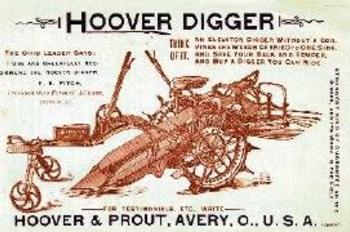
Before widespread mechanization, potato harvests required entire families and long days of physical labor. Hoover knew this work firsthand. Determined to ease the burden, he designed and built the Hoover Potato Digger in the mid-1880s. The machine loosened soil and lifted potatoes to the surface, dramatically reducing the back-breaking work that once defined harvest season. What had taken days of bending, digging, and lifting could now be done far more efficiently.
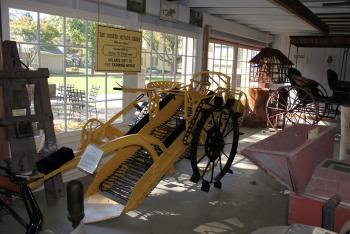 Hoover’s invention spread quickly, becoming widely used across the country and helping to transform American agriculture. Yet even as machines improved, human labor (often young labor) remained an essential part of the process.
That reality is reflected in my own family’s story.
From 1961 to 1963, when my mom, Connie, was just 14-16 years old, she worked for Graham Farms in Dresden, Ohio. Because her own mother was working and public transportation wasn’t available, she hitchhiked to the farm each day, something that feels almost unimaginable now. When she arrived, she checked in at the barn, received a batch of tickets, and was assigned her row numbers: her identifier for the day’s work.
Her shift ran from 8 am-5 pm, with only a half-hour lunch break, eaten right there in the field. Lunch was whatever she brought from home, and water was shared communally, with everyone drinking from the same dipper.
She and the other workers (mostly teenagers, along with a few mothers and younger children) were loaded onto a wagon and taken out to the potato fields. By then, the potatoes had already been mechanically dug and lay scattered across the ground. Their job was to pick up each potato by hand, rub off the dirt and any remaining tubers, and place them into a bushel basket.
Once a basket was full, she slipped her assigned ticket inside. Another wagon made the rounds to collect the baskets and haul them back to the barn for grading and bagging. Payment was simple and unforgiving: six cents per bushel.
 Her experience helps explain why Isaac Hoover’s invention mattered so deeply. The potato digger wasn’t just about efficiency; it was about reducing the human toll of harvest. Even decades after Hoover’s machine loosened the soil and lifted the crop, children and teens were still spending long days in the fields to finish the work by hand. Hoover saw that reality on his own farm in Avery and set out to change it. His invention marked a turning point - one that slowly eased labor demands, shortened harvest time, and began shifting expectations about who should bear the hardest work of feeding the nation.
As we mark America’s 250th anniversary, stories like these remind us that innovation isn’t only found in famous laboratories or headline-making inventions. It also lives in fields, barns, and small communities shaped by people like Thomas Edison, whose ideas powered a nation, and Isaac Hoover, whose practical ingenuity transformed everyday farm life. Together, their stories reflect the American spirit of problem-solving and progress and the countless hands, young and old, whose labor made that progress possible.
Today, the legacy of Isaac Hoover’s innovation can still be seen locally. A Hoover Potato Digger is on display at the Milan Museum, offering a tangible reminder of how Ohio-made ingenuity helped transform farm labor and how closely this history is tied to the communities where it all began.
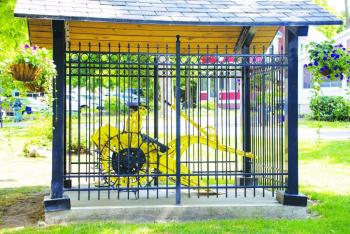
 That legacy extends beyond the fields as well. Hoover Auditorium in Lakeside, Ohio, is connected to the very same Hoover family behind the potato digger. The auditorium is named after Arthur L. Hoover, son of Isaac Hoover, and a Hoover Potato Digger displayed near the building serves as a visible link between the family’s agricultural innovation and their lasting impact on cultural and community life along Ohio’s Shores & Islands.
Join Us for February’s Time Traveler Talk
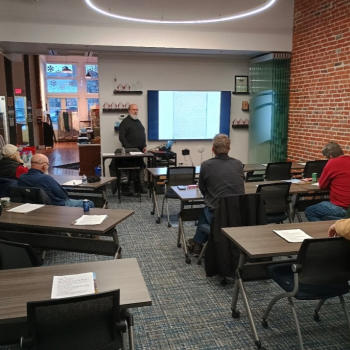
To continue exploring Ohio’s legacy of innovation, join us for The Time Traveler: Shores & Islands History Talk on February 24 from 5:30–6:30 pm. at the Shores & Islands East Welcome Center, located at 125 E. Water St., Sandusky. Edison descendant, Robert Wheeler will present a talk on the Edison Family, offering deeper insight into the people and place that shaped one of America’s most influential inventors. No registration is required, free admission, and light refreshments will be provided.