Thought Milan was only famous as the home of Thomas Edison? Shores & Islands Ohio Travel counselor Glenda shares this guest post to educate us on another side of Milan and a unique tie to her hometown!
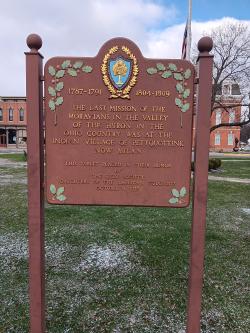 Hi. I’m Glenda, a visitor experience specialist at Shores and Islands Ohio. I grew up in the Dover -New Philadelphia, Ohio (the Tuscarawas Valley) area. Shortly after I moved to the Firelands area, I was in Milan, Ohio walking around the square and I saw a historical marker the surprised me.
This marker was a link in my life between my new home and where I grew up. My excitement grew into research about a part of the Moravian story that I had never heard: The Moravian settlement at Pequotting was to become the village of Milan. This settlement was first established at New Salem (Fries Landing) by David Zeisberger. Several years after that settlement closed (and the Zeisberger group went back to the Tuscarawas Valley area), Rev C F Dencske established the settlement as Petquotting, with Gottfried Sebastian Oppelt as pastor.
The Moravian community in my home area, Schoenbrunn, held intrigue for me because of their stand for helping people, their bravery, and their hope in the face of constant opposition.
From my point of view, the Moravian missionaries and their flock of Delaware native peoples, who moved to Ohio from Bethlehem, PA to pass the good news of their faith to other native peoples. The Moravians are a quiet people who believe in passivism, helping others, and following their faith.
When growing up, I realized that my area held a little known, (but very important) spot in American history. It was an act that kept the 12 Native people tribes on the side of the American Revolution.
Actors:
David Zeisberger – leader of the Schoenbrunn settlement and founder of the New Salem mission in Milan Township
John Heckewelter – teacher at Schoenbrunn
Chief White Eye – leader of the 12 Nations
Captain Pipe – Delaware leader who was not in favor of the Moravian group, but respected them. His territory covered most of central and northern Ohio.
Simon Girty – a British supporter who would go to any length to support his cause
Moravian Native Americans
Rev. D F Dencke – founder of Pequotting (Milan)
Gottfried Sebastian Oppelt – pastor at Pequotting
 Plot: Moravian missionaries were living and working with the Native population in North America at the time of the American Revolution. One of their beliefs was passivism. That was a tough stance to take during a war. The Moravian mission group (made up of the Delaware and their Moravian teachers) helped both the American and British sides of the war. The 12 Nations of the native population favored the 13 colonies. The native nations respected what the Moravian missionaries were doing to help their people.
Enter: Simon Girty, a white settler who was on the side of the British. Simon Girty wanted to sway the 12 Nations to the side of the British. He told Chief White Eyes, chief of the 12 Nations, that George Washington and all the Continental Congress had been slain and the 12 Tribes should side with the British.
Action: There was an attempt to persuade the 12 Nations to support the British sympathizers and move to the side of the British. However, the 12 Nations’ chief, Chief White Eyes, was convinced to wait 10 days before giving his answer. This gave John Heckewelter (Moravian teacher) time to go east and find out what was going on with the colonies. Upon returning to the Ohio Valley and speaking to Chief White Eyes, Heckewelter brought a letter from George Washington and was able to convince Chief White Eyes that the American Revolution was still very much alive. “Burying the Hatchet” by the 12 Nations was pivotal in support of the establishment of the United States.
Results: The influence of the Moravian missionaries to the Native American population was interesting. Not all the native people supported the Moravians, but they respected their efforts on behalf of the people. When the ramifications of supporting both sides in the revolution began to affect the safety of the Moravians, they became people who had a way of life the that was “on the road”. The effects of passivism followed them wherever they lived. One of their biggest oppositionists was a Delaware leader with the common name of Captain Pipe. Although Captain Pipe never befriended the movement, he respected the work they did among his Delaware people. Also, the Moravians told the truth (unlike his friend, Simon Girty). Therefore, wherever they lived, Captain Pipe would send word to the Moravians when they were in danger so they could move on and establish a new place of residency.
There was a reason this protection was so important and so amazing. You see, danger had become a reality and they were only too aware of the truth of their constant situation.
To see the whole story of the danger they lived with, take a trip to the Tuscarawas Valley. Attend the outdoor drama, “Trumpet in the Land” and visit the rebuild village of Schoenbrunn which would have been very much like the villages of New Salem (in Milan Township) and Pequotting (Milan). New Salem was established by David Zeisberger when he and his group lived in the Milan area. This area was the last U.S. home of the Schoebnrunn Moravians before it became safe for them to return to the Tuscarawas Valley.
Through opposition, struggle and faith, I present a people whose hope in the future laid a foundation for our lives. They have touched all of us and because of them just quietly living their beliefs, they helped establish our nation and we barely even know how important this unassuming group was in the development of our nation.
Learn more about the origin and history of Milan, Ohio at the Milan Museum!