 In the early 1900s commerce on Lake Erie centered around fishing and freight. Technology was advancing in transportation, and other sectors were feeling a trickle-down effect. For example, people started to enjoy the idea of pleasure travel or vacationing. Families did not have to arrange expensive or long-distance trips. The era of the steamship was right around the corner. These ships moved people and freight for years while making history in the Great Lakes region.
Steamboats on the Great Lakes grew in number. The 1825 opening of the Erie Canal opened a water route for travelers from New England to Michigan. Leisure cruising became popular, and many resorts were only accessible by steamer. Advancements like the screw propeller and triple or quadruple expansion engines allowed greater efficiency, and designing ships with passenger quarters on the upper deck left the main holds open for cargo.
As things like work week hours changed along with the middle classes being able to afford some luxuries, people began to realize the idea of getting out of the crowded city. Popular destinations included some of our very own shores; Put-in-Bay, Cedar Point, Lakeside, and other pleasure resorts. The steamboats connected major industrial centers while also delivering people through scheduled runs. This was before the era of personal automobiles, and catching a steamship was an easy way to become a tourist.
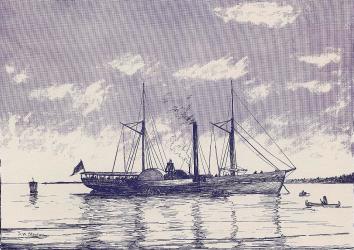
The ship with the claim of being the first steamboat on Lake Erie is most likely the Walk-In-The-Water in 1818. This was a paddlewheel-driven boat that had a capacity of roughly 100 passengers. The vessel could travel at the chug along pace of 10 mph and cost $18 for a cabin or $7 for steerage. In nine days, the ship could complete a run from Buffalo to Detroit with several stops in-between. In 1821, Walk-In-The-Water hit foul weather and was wrecked. Her engine lived on by being placed into another steamship, the Superior.
The steamer Put-In-Bay was a notable tool in growing tourism destinations. She ferried leisure travelers between Detroit, Sandusky, Cedar Point, and of course South Bass Island. In 1911 the ship was christened in Michigan, using none other than Sandusky-made champagne. The steamer was 240 ft long and could hold 3000 passengers. For 70 cents, in 1918, passengers could purchase a weekday round trip ticket. In today’s dollar amount, that round trip would be roughly $14.50. For nearly forty years the island’s fun of wine and sunshine, or thrills of Cedar Point, could be accessed via The Put-In-Bay each season by eager passengers.
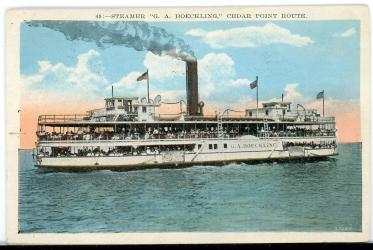
Another steamer that was beloved by Sanduskians was the G.A.Boeckling. The steel steamer had been built exclusively for Cedar Point routes. Capable of steaming in both directions, as she featured two pilothouses, the ship did not need to execute a turnaround maneuver in the bay. Uniquely, passengers could view the massive steam engine midship as it had an open-air design. There was even an ice water station to quench the 2000 passengers she could carry, though one can imagine it may have been more tepid than anything with the temperatures generated by the open-air engines.
The last trip taken by the Boeckling was Labor Day 1951. Rising costs of fuel, maintenance, and staffing issues led to the retirement of the boat. Sold to a machine company in Wisconsin to be used as a floating warehouse in 1953; it was not the end of the ship’s narrative. She eventually made a historic return to Sandusky, Ohio in 1983 when a group of locals attempted to organize plans to rehab the steamer. A tugboat chugged through Sandusky Bay that June towing the steamer while an excited crowd looked on from Jackson Street Pier. The plan was to restore the vessel was unfortunately never brought to fruition, as unknown circumstances led her to be destroyed by a fire in 1989 at a Toledo shipyard.
Though tragedy of course plagued some steamships on their routes, one that withstood a literal tornado was the steamer Chippewa. In 1924 the ship stayed afloat in Sandusky Bay near Jackson Street Pier, while other ships in the vicinity foundered. This happened only two years into her service career for the Sandusky, Put-in-Bay, and Lakeside route. The iron side-wheeler went on to offer service for the Sandusky and Islands Steamboat Company until 1938. The vessel hosted occasional orchestra events to entertain passengers and twilight cruises. When passenger traffic started to dwindle in autumn, the ship would carry grapes as cargo in the wine making trade to Detroit.
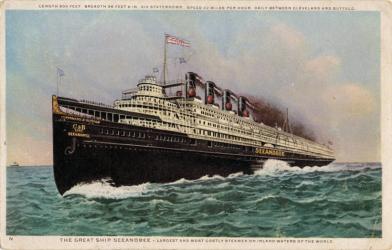
The passenger steamer Seeandbee was massive for her time. So large you could land a plane on her! We will revisit that in just a moment. The coal-fired sidewheel steamer was 500 ft long and was the only one to have four smokestacks. Meant to be an overnight passenger vessel, the boat navigated the economic turbulence of the 1930s by removing staterooms in favor of a dance hall. Personal automobiles were becoming the norm and cruising was declining in popularity. In 1941, inter Great Lakes travel had a mini revival as wartime curtailed ocean cruises.
This revival was short lived but was followed by a most unlikely change in career for the liner. The bombing of Pearl Harbor, and subsequent entry into WWII, spurred the need for aircraft carriers. With her decks and upper works removed, she was commissioned as in 1942 as the aircraft carrier USS Wolverine. For the next handful of years United States Airforce pilots were trained on the carrier, located in Lake Michigan. Among those pilots was a future President, George Bush Sr.
Though there are still ferry services on the Great Lakes, leisure cruising has given way to more service-based trips. Some examples would be the Miller Ferry with service to Put-in-Bay, Kelleys Island Ferry with service to Kelleys Island, or The Islander with service to Pelee Island. These locations are still busy spring and summer destinations for travelers. The Goodtime I offers pleasure sunset cruises, along with island hopping, from Jackson Street Pier through the warmer months.
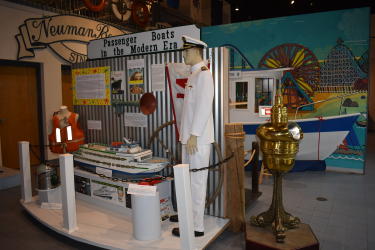 It is hard to note each historic steamer on the Great Lakes and all their adventures. The highs and lows of the steamer era are rich in history, tragedy, and innovation. Places on our very shores that we know, and love were shaped by the tourism industry these ships carried. Steamers, means of transportation for both passengers and raw material freight, were crucial in turning locales from fledgling haunts to hubs of family traditions.
*To learn more about Lake Erie steamships, visit the Maritime Museum of Sandusky!